
FIELD NOTES / HONEYCOMB
Wood-Effect Finishes on Honeycomb Panels: What Lasts Outdoors
A wood-effect finish on a honeycomb panel is a coating system, not a wood surface — and whether it lasts outdoors depends on the system, the edges and the evidence behind it.
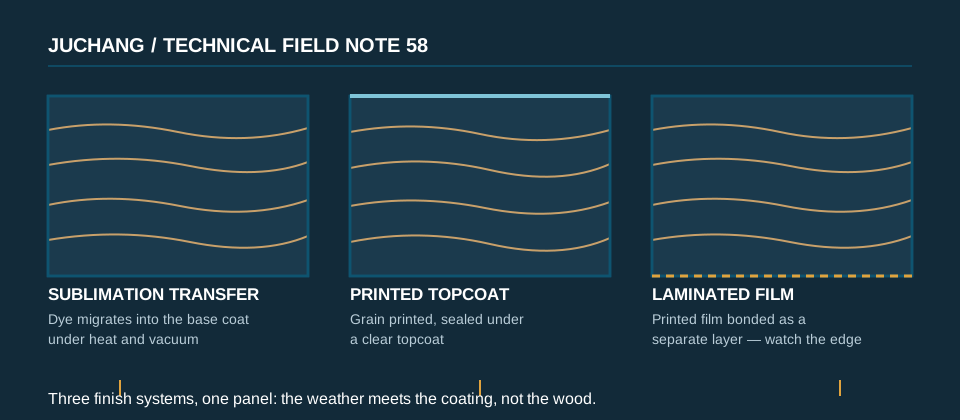
A wood-effect finish is a coating system, not a wood surface
When a specifier asks for a wood effect honeycomb panel finish, the word "wood" describes the look, not the material. The visible face is still aluminum, and the grain is a printed or transferred pattern held in a coating system. That distinction matters outdoors, because the finish ages the way a coating ages: by fading, chalking, losing gloss and eventually losing adhesion — not by greying and splitting the way timber does. A buyer who judges the panel as if it were wood will ask the wrong questions and get the wrong evidence.
Most wood-effect systems for aluminum panels fall into three broad families, and the first question to put to a supplier is which one is being offered. In a sublimation transfer system, a printed film is pressed against a powder-coated base coat under heat and vacuum, and the dye migrates into the coating. In a printed PVDF or polyester system, the grain is printed onto the coil or sheet and sealed under a clear topcoat. In a laminated system, a printed film is bonded to the face sheet as a separate layer. Each family has different failure modes: a transfer print can fade unevenly if the dye and base coat are mismatched, a printed topcoat can chalk or lose gloss at the surface, and a laminated film can lift at an edge or a cut. The panel underneath is the same honeycomb sandwich in all three cases; what changes is the layer the weather actually touches.
That is why a quotation that simply says "wood effect" is not a specification. It should name the system family, the base coat, the clear coat where one exists, and the coating supplier's product designation for that exact combination. Two panels can show the same grain on a small sample and behave very differently after a few summers, because the difference sits in layers the eye cannot separate. Ask for the system to be named in writing, and treat any answer that only names a colour or a grain pattern as incomplete.
What outdoor exposure actually does to the finish
Sunlight is the first test. Ultraviolet radiation breaks down the resins and dyes in a coating, and the visible result is usually a loss of colour depth before any structural problem appears. A wood grain is particularly unforgiving here, because fading does not happen evenly across the pattern: the darker grain lines and the lighter background can fade at different rates, so the panel can look washed out or oddly flat long before the coating itself has failed. Ask the coating supplier for weathering evidence for the proposed system — accelerated weathering records, and outdoor exposure records where they exist — and check that the evidence belongs to the same system family, base coat and clear coat being offered, not to a different product in the same brochure.
Moisture attacks from the edges rather than the face. A honeycomb panel face is a sealed coated sheet, but a cut edge, a folded return, a fixing hole or an open joint is a route in. Water that sits at an edge can work under a coating, and freeze-thaw cycles can widen that path. This is why the finish question cannot be separated from the edge-closure question: an edge that is left open, or closed with a detail that traps water, will age the finish faster than the same coating on a well-drained panel. The ALUCORE processing guide discusses edge treatment and moisture exposure for outdoor panels, and its guidance is a useful check on whether the proposed edge detail has been thought through at all.
Temperature cycling adds a third load. A dark wood tone absorbs more heat than a pale one, and the face sheet expands and contracts against the core and the fixings. The movement itself is small, but repeated daily cycles over years test the bond between the coating layers and between the coating and the metal. Panels on a south-facing elevation in a hot climate carry a heavier version of this test than the same panels on a shaded north wall, so a single weathering claim for "outdoor use" should be read against the project's actual orientation and climate. Confirm per project and drawing — a finish that is adequate for a sheltered canopy may not be the right choice for a full-sun facade.
What to ask about the coating before ordering
A useful enquiry names the evidence, not the adjectives. Ask for the coating system designation, the base coat and clear coat, and the coating supplier's written weathering data for that combination. Ask which accelerated weathering test was run, how long it ran, and what the measured change was — gloss loss, colour change, chalking — rather than accepting a summary such as "exterior grade". A number without a test method and a duration is not evidence; a test report for a different system is not evidence for this one. If the supplier cannot produce records for the proposed combination, that is a finding in itself.
Ask separately about the grain. Wood-effect patterns are printed from artwork with a repeat length, and the repeat decides whether a wide panel reads as timber or as wallpaper. On a large cassette the same grain motif may repeat two or three times across the face, and the repetition becomes visible from the pavement. Ask for the repeat length, and for a sample at least as wide as one panel module, so the repeat can be judged at the scale it will be installed. Also ask whether the grain runs in a fixed direction relative to the panel, and whether the factory controls that direction through cutting and folding — a grain that turns ninety degrees between adjacent panels is a defect the sample will not show if every sample is cut the same way.
Finally, ask what the coating supplier excludes. Some systems carry different terms for horizontal surfaces, for coastal exposure, or for panels installed within reach of cleaning equipment. The exclusions are as informative as the coverage, because they mark the conditions the system was not designed for. Record the answers in the specification, with the system designation and the evidence referenced by document.
Judge the sample the way the facade will be judged
A wood-effect sample fails as evidence when it is judged under the wrong conditions. A small chip viewed indoors under office lighting tells the team almost nothing about a facade: the grain scale is wrong, the gloss reads differently, and the colour shifts under daylight. Ask for a full-size sample panel, or at minimum a sample large enough to show one full grain repeat, and view it outdoors, in daylight, at the distance the facade will be seen from. Stand back far enough that the joint lines and the panel module are part of the view, because a finish that looks convincing at arm's length can look repetitive at ten metres.
Check the sample against the batch question as well. Wood-effect coatings are produced in lots, and the grain print and the base coat can drift between lots. A single approved sample does not prove that the hundredth panel will match it. Ask how the factory controls lot variation — whether panels for one elevation are drawn from a single lot, how a replacement panel is matched, and what happens if a later lot reads differently. The answer should be a procedure, not a reassurance. Where the project has more than one elevation, decide in advance which elevations share a lot and record it on the panel schedule.
Keep the approved sample, labelled with the system designation, the lot and the approval date, and keep it out of direct sunlight so it remains a valid reference. A sample stored on a sunny windowsill fades alongside the building and proves nothing a year later. When a delivery arrives, compare a panel from the shipment with the retained sample under the same daylight conditions before installation begins, and record the comparison.
Joints, edges and cleaning decide how long the look survives
The grain does not stop at the joint, but the pattern does. Where two panels meet, the grain will break, and the break will be visible if the panels are installed without any thought to pattern continuity. On a long elevation the team should decide whether grain direction is continuous across joints, whether panels are sequenced so that the grain flows, and whether a joint is placed to hide a repeat boundary or exposes it. These are layout decisions, not factory decisions, and they belong on the elevation drawing before fabrication starts. A panel schedule that only lists sizes cannot answer them.
Edges deserve the same attention. A wood-effect face that wraps around a folded return will show the grain bending at the fold, and a cut edge will show the coating's edge and the metal beneath it. Ask how the proposed edge is finished — whether the coating wraps the fold, whether the edge is closed with a profile, and whether the closure is sealed against moisture. An unfinished cut edge on an exterior panel is a weathering risk and a visual one, and it is far cheaper to resolve on the drawing than to dress after installation.
Cleaning is the last part of the durability question, and it is the part most often left to the facilities team to discover. A wood-effect coating has a cleaning method, a permitted cleaner and a frequency, and the wrong cleaner or an abrasive pad can dull the clear coat in a single pass. Ask the coating supplier for written cleaning instructions for the exact system, and put them in the maintenance manual with the system designation attached. A finish that lasts outdoors is not only a coating that resists the weather; it is a coating whose care instructions survive the handover.
Technical references
The sources describe general engineering considerations. Confirm product-specific values and project requirements with the responsible design team.