
FIELD NOTES / HONEYCOMB
Honeycomb Panel Warranty Terms: A Checklist Before You Sign
A honeycomb panel warranty terms checklist starts from one fact: the document you sign is rarely a single promise. Finish, bond and workmanship are usually covered by different parties, for different periods, under different conditions — and the only way to know what you hold is to read each term against the project it belongs to, confirmed per project and drawing.
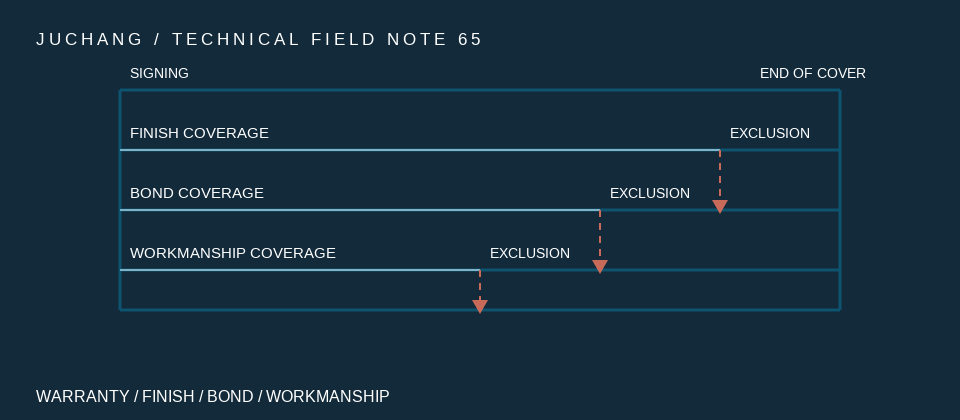
A honeycomb panel warranty is several warranties, not one
The first mistake is to ask for "the warranty" as though it were one document with one number. On a honeycomb panel project it is usually three promises that happen to arrive together: the coating or finish warranty, the bond warranty for the skin-to-core adhesive, and the workmanship warranty for fabrication and installation. Each is written by a different party, covers a different failure, and runs for a different period. A panel can be inside its finish warranty and outside its workmanship warranty on the same day, and a claim that names the wrong promise will be refused even when the defect is real.
Start by separating the three. The finish warranty is normally issued by the coating supplier or the panel manufacturer for the coating system that was actually applied — the exact finish, not a generic product range. Ask who issues it, whether it covers chalking, fading, peeling or cracking, and how each of those is measured. A finish warranty that promises a surface will "perform" without defining the test or the threshold is a promise that cannot be claimed, because nobody can agree when it has been broken.
The bond warranty covers the adhesive joint between the face sheets and the honeycomb core. It is the promise that matters most to a structural panel, and it is the one least often read. Ask what it covers — delamination, skin separation, loss of flatness caused by bond failure — and what evidence the issuer requires before it will accept that a failure is a bond failure rather than damage. The workmanship warranty, usually the shortest of the three, covers fabrication and installation: folded returns, edge closure, inserts, fixings and joint work. On most projects it is issued by the fabricator or the installer, not the panel manufacturer, which is why a defect at a fixing can fall between two warranties and belong to neither.
Write the three down before the order is placed: issuer, covered failures, duration and governing document for each. If any row is blank, the warranty for that part does not exist yet — it is only an assumption, and assumptions do not pay for replacements.
Duration means little until the start date is fixed
A warranty period is a number with a start date attached, and the start date is where the years quietly disappear. Some warranties run from the date of manufacture, some from delivery to site, some from practical completion or handover, and some from the date the panel was installed. On a project where panels are manufactured months before they are installed, a warranty counted from manufacture can be half spent before the building opens. Ask for the start trigger in writing, for each of the three warranties separately, and check that the trigger is an event the project can actually record — a signed delivery note, a handover certificate — not a date nobody will remember.
Ask also whether the period is full cover or stepped. Some warranties cover the full cost of replacement for an initial period and then reduce — the supplier pays a smaller share, or only the material and not the labour, as the years pass. A headline number that sounds long can be mostly stepped cover. Find out, before signing, whether removal, access and reinstallation are inside the warranty: a warranty that replaces the panel but not the work of reaching it leaves the most expensive part of the repair with the owner.
Transfer is the third question the duration raises. If the building changes hands, does the warranty follow the building or die with the original buyer? Some warranties transfer once, some transfer only with the issuer's written consent, and some do not transfer at all. If the project is a development that will be sold, the answer changes the value of the warranty to the next owner, and it should be settled while the supplier still wants the order.
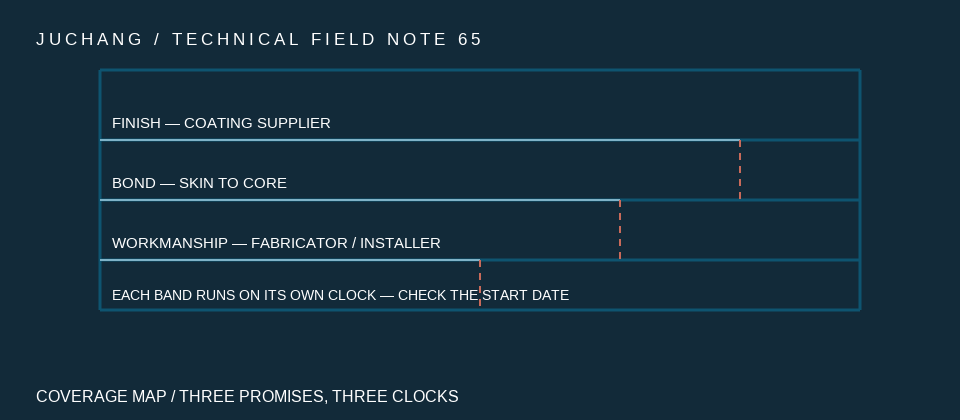
Exclusions decide more claims than the headline term does
Most warranty disputes are not about whether a defect exists, but whether it falls inside an exclusion — written in the part of the document nobody reads until the claim is refused. The common ones on honeycomb panel projects are worth reading line by line: damage during transport or site handling, installation that departs from the approved shop drawings, fixings or sealants the warranty issuer did not approve, cleaning with chemicals the coating supplier did not approve, and exposure beyond the environment the panel was specified for.
Two exclusions deserve particular attention. The first is the cleaning exclusion. A finish warranty will often require the panels to be cleaned in a stated way, at a stated interval, with stated products. If the facilities team cleans the facade with a product the coating supplier never approved, the finish warranty can be voided for the whole elevation — not just the panels that were cleaned. Ask for the cleaning instructions in writing, for the exact finish, and make sure they reach the team that will actually clean the building, not only the file that holds the warranty.
The second is the environment exclusion. A warranty written for a normal urban facade may exclude coastal, industrial or chemical exposure, and a panel installed above a pool, beside a road or near the sea may sit outside the stated environment from the day it is fitted. The specification should state the environment the panels will live in, and the warranty should be confirmed against that same environment, in writing, before the order is placed. A warranty that does not name the project's environment has not been checked against it.
Finally, read what the warranty says about modifications. Panels cut on site for a late service opening, a sign fixed through the face sheet, or a hatch added after handover can all sit outside the original warranty if the document says so. If the building will change — and most buildings do — ask how a modification is recorded and re-approved, so that a small change does not quietly cancel the cover on a whole elevation.
A claim is won or lost on the records you kept
When a warranty claim is made, the issuer's first question is rarely "what failed?" It is "show me the records." A claim without records becomes a negotiation about what happened, and the party with the records wins it. The records a honeycomb panel claim will ask for are predictable — collect them as the project runs, not after the defect appears: the panel schedule with batch or lot numbers, the approved shop drawings and their revision history, the sample approval record, the delivery notes, the installation records showing who fixed what and when, and the inspection and cleaning logs.
Panel identification is the record most often missing. If the panels on an elevation cannot be traced to a batch, a production run or a delivery, the issuer cannot tell whether the affected panels share a cause or are unrelated, and the claim slows down while the question is argued. Give every panel a number on the schedule, keep the number through fabrication, delivery and installation, and make sure the as-built record shows which panel went where. A claim that can point to panel numbers, a drawing revision and a photograph is a claim that can be answered.
The claim procedure itself should be read before it is needed. Ask how a claim is notified — in writing, to whom, within how many days of discovery — and what the issuer must do next: inspect within a stated period, respond within a stated period, and decide within a stated period. A warranty with no response times is a warranty that can be answered slowly, and slow answers on a facade defect mean water, staining or a safety concern left in place while the paperwork waits. Keep the notification in writing from the first contact, with photographs and dates, and keep a copy outside the project file.
The checklist to run before you sign
Before the warranty is signed, run the document against this checklist, and get the answers in writing — a verbal assurance from a sales meeting is not a warranty term. First, the three coverages: finish, bond and workmanship, each with its issuer, its covered failures, its duration and its start trigger. Second, the exclusions, read in full, checked against the project's environment, cleaning regime and likely modifications. Third, the claim route: who to notify, how, within how many days, and what response times the issuer commits to. Fourth, what the warranty pays for — material only, or material plus removal, access and reinstallation — and whether cover is full or stepped over time.
Fifth, who warrants what when more than one party is involved. The panel manufacturer, the coating supplier, the fabricator and the installer each warrant their own part, and the gaps between them are where claims die. Ask for one page — it can be a simple table — that maps each part of the panel to the party that warrants it, so that a defect at a fixing, an edge or a finish has an owner before it happens. Sixth, transfer: whether the warranty follows the building, and what consent or notice a transfer needs.
Finally, check that the warranty matches the documents it sits beside. The panel described in the warranty should be the panel described in the specification and the approved shop drawings — the same build-up, the same finish, the same edge closure, the same environment. If the warranty describes a different panel, or a different finish, or an environment the project does not have, it is not the project's warranty yet. Get it corrected before the order is placed, while the correction costs nothing. A warranty signed without this check is not protection; it is a document that will be read for the first time on the worst day of the project.
Technical references
The sources describe general engineering considerations. Confirm product-specific values and project requirements with the responsible design team.