
FIELD NOTES / HONEYCOMB
A Honeycomb Panel Specification Template for Architects
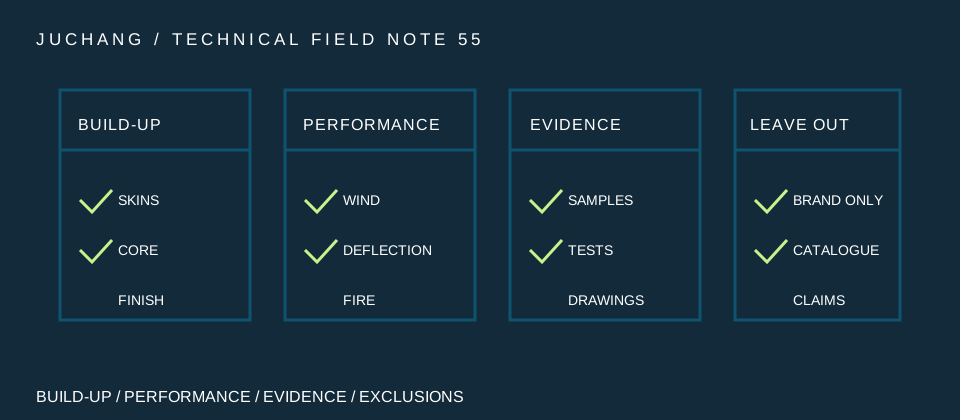
A honeycomb panel specification template is useful only if a supplier can price from it and a reviewer can check against it. The template below is written around the decisions an architect actually has to make — the panel build-up, the performance inputs, the evidence to ask for, and the clauses that should never appear — so that the specification states what the project needs instead of repeating what a catalogue says.
A specification template is a set of decisions, not a form
Most honeycomb panel specifications fail in the same way. They copy a catalogue paragraph, add a thickness and a colour, and leave the rest to the supplier. The supplier then has to guess the build-up, the loads, the supports and the finish, and the price that comes back is a price for a different panel than the one the architect imagined. When the panels arrive, the drawing set has no record of what was actually agreed, so nobody can say whether the delivery matches the specification.
A good specification template works the other way around. It is a short list of decisions, each with a place for the project value and a place for the evidence that proves it. The template below follows the order a project should decide things: first the panel itself, then what it has to do, then what the supplier must prove, and finally what the specification must not say. Use it as a starting point and fill in the project values from the drawings and the engineering — never from a catalogue.
The keyword to keep in mind is honeycomb panel specification template for architects: the document is written for the architect who has to issue it, not for the supplier who has to read it. Every clause should answer a question a supplier would otherwise have to ask, and every value should be traceable to a drawing, a calculation or a test report — not to a brochure.
Clause 1: the panel build-up, written so nothing is assumed
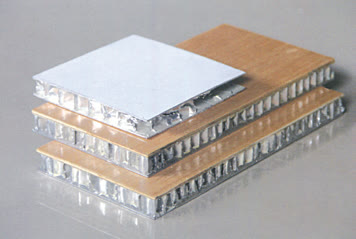
The first clause of the template names the panel. A statement such as “25 mm honeycomb panel” leaves several variables unknown, and two panels with the same overall depth can behave differently when the skins, the core or the bond differ. The template should ask for each element by name: outer skin alloy and thickness, inner skin alloy and thickness, honeycomb core material and depth, cell size or density where the project specifies it, bonding system, total nominal thickness, edge closure, and surface coating with its system and gloss level.
State whether each dimension applies to the flat sheet or to the finished cassette with folded returns, because the two are not the same number. A folded return adds depth at the edge and changes how the panel is measured, fixed and sealed, so the drawing and the specification must agree on which dimension they are using. The template should also state the orientation of the core ribbon direction where it matters, and whether the panel is supplied as a flat sheet, a folded cassette, or a curved cassette.
The finish clause deserves the same precision. A colour code alone does not capture gloss, texture or metallic direction, and a finish that looks right on a small sample can read differently across a whole elevation. The template should require an approved sample of the exact finish on the exact build-up, viewed under the lighting the facade will actually live under, and it should state how batch colour variation will be controlled and how panels will be sequenced on the elevation. The ALUCORE processing guide describes edge treatment and coating selection for honeycomb panels in general terms; apply its principles to the proposed build-up and confirm the detail per project.
Clause 2: performance inputs the supplier cannot invent
The second clause of the template states what the panel has to do. This is the part most specifications leave blank, and it is the part that decides whether the panel is fit for the project. The template should ask for the design wind pressure, the support spacing, the project deflection limit, the fixing arrangement, and the exposure the panel will face — exterior, interior, coastal, high humidity, or a combination of them. Each of these is a project value: confirm per project and per drawing, and never copy a value from another project or a catalogue.
Wind pressure deserves a line of its own. A panel can appear stiff at midspan while failing locally near a fastener, an insert or an edge, so the template should ask how loads transfer from the outer skin into the core and through the approved fixing to the subframe. The engineer should check core shear, facing stress, local compression and face wrinkling where relevant, following the approach in Hexcel’s sandwich design guidance: loading, support condition and physical constraints first, then skins and core. A deflection claim has meaning only with a stated support arrangement, load, panel build-up and deflection criterion.
Fire and other regulatory requirements belong in this clause too, but only as the requirement and the evidence that proves it — never as a bare rating. Fire performance depends on what was tested and how the report applies to the intended use, so the template should ask for the test report, the build-up that was tested, and the scope of the report. The same applies to acoustic or thermal requirements: state the outcome the project needs, and ask for the evidence that the proposed build-up achieves it. If the project has no such requirement, the template should say so explicitly, rather than leaving the line blank for someone else to fill in later.
Illustrative example only — the project values come from the project specification: consider a facade where the design team sets the wind pressure and the support spacing, then discovers that the largest cassette the elevation wants cannot be fixed to the rail spacing the structure provides. The choice is to change the module, change the rail, or change the fixing — and each choice changes the joint layout, the number of panels and the price. Confirm the performance inputs before the module size is frozen, not after the panels are ordered.
Clause 3: evidence — samples, tests and submittals
The third clause of the template is the evidence. A specification that states a build-up and a performance requirement but asks for no proof is a wish list, not a contract document. The template should list the submittals the supplier must provide before fabrication: shop drawings showing the panel build-up, the folded returns, the fixing arrangement and the joint widths; material certificates for the skins and the core; test reports tied to the proposed build-up; and a sample approval record.
The sample clause should be written as a workflow, not a single line. A sample should answer a specific question — the finish, the edge closure, the fold, the fixing — and the template should state which question each sample answers, who approves it, and what happens to the decision once it is made. A mock-up proves intent, not production: it settles the appearance and the detail, but it cannot settle the production panels, which is why the template should also require a first-production inspection and a record that links each panel to its part ID and production lot.
Pull-out evidence belongs here as well. Where a panel carries a fixing, an insert or a fixture, the template should ask for the pull-out result for that insert in that build-up, with the fastener geometry, the engagement material and the specimen configuration stated. A fastener result from a different build-up is not evidence for this one. The same rule applies to any test report: the report is evidence only for the build-up it was tested on, and the template should ask the supplier to identify any assumption the report does not cover.
Clause 4: the clauses to leave out
The last part of the template is the list of clauses to leave out, and it is the part most templates never write. A specification should not name a single brand without an “or equal” basis and a stated performance comparison, because a brand-only clause stops competition and hides the actual requirement. It should not state a single thickness as the whole build-up, because thickness alone proves nothing about the skins, the core or the bond. It should not copy a catalogue performance claim as a project requirement, because a catalogue value belongs to the catalogue’s build-up, not to this project’s.
The template should also avoid clauses that cannot be checked. “High quality”, “to the architect’s satisfaction” and “as required” are not specifications: they cannot be measured, they cannot be tested, and they cannot be enforced. Every clause should name the value, the tolerance, the test or the sample that proves it. Where the project team does not yet know a value, the template should say so and name who will decide it and by when — a blank line with an owner and a date is more useful than a guessed number that nobody will revisit.
Finally, the template should state how it will be used. The specification is a living document through design development: drawing revisions, changes to openings or returns, and late decisions about finish or fixing can all affect machining, material yield and panels already in production. The template should require that every revision is recorded, that the panel schedule is updated with it, and that the supplier confirms in writing whether the change affects panels already made. A specification template that is filled in once and never revised is a record of what the project used to want. The template in this guide is a starting point — fill it in from the project drawings and the project engineering, keep the evidence with it, and let it change as the project does.
Technical references
The sources describe general engineering considerations. Confirm product-specific values and project requirements with the responsible design team.