
FIELD NOTES / HONEYCOMB
Planning Honeycomb Panel Lead Time for Facade Projects
Honeycomb panel lead time is a sequence of drawing approval, sampling, production slots and site readiness — plan the gates, not just the date.
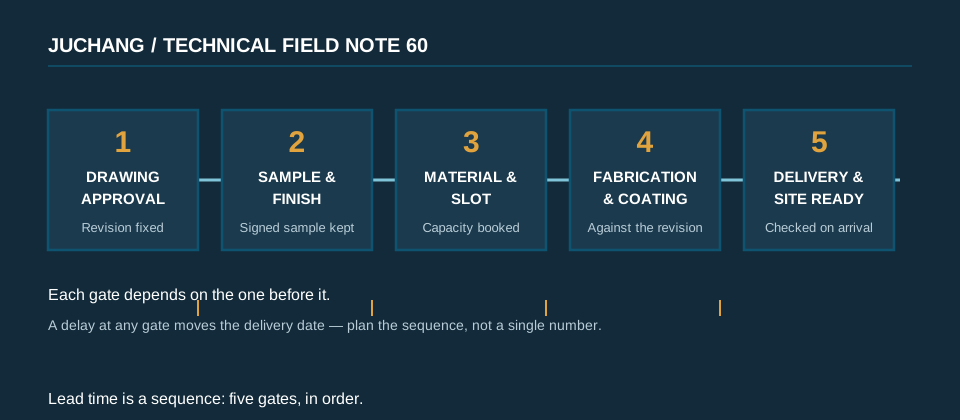
Plan the honeycomb panel lead time as a sequence of gates
A honeycomb panel lead time is often quoted as a single number, and that number is where most facade programmes go wrong. A panel cannot be fabricated until the drawings are approved, the finish is signed off, the material is reserved and a production slot is held — and it cannot be delivered until the site is ready to receive it. Each of those steps depends on the one before it, and each has its own owner, its own evidence and its own way of slipping. When a delivery date moves, the cause is usually not the press or the coating line. It is a gate that was never planned as a gate.
Plan the lead time as a sequence instead. List the gates in order, name the person who clears each one, state what evidence clears it, and agree what happens to the delivery date when a gate moves. A facade contractor who can see the sequence can protect it. A buyer who only has a single number cannot tell whether the date is realistic, and cannot tell which delay matters and which one can be absorbed. The rest of this guide walks through the five gates in the order they occur, and what to put in writing at each one.
Drawing approval: the first gate, and the one that slips most
Nothing in the fabrication sequence starts before the shop drawings are approved, so drawing approval is the gate that sets the clock. The approval package for a honeycomb panel facade normally includes the panel schedule with part numbers and finished sizes, the elevation drawings showing panel locations, the fixing and interface details, the build-up with face sheets, core and edge closure, and the finish specification. If any of those documents is missing, the fabricator cannot confirm material, cannot nest the panels for cutting and cannot book a coating slot with confidence.
Most drawing delays are not drafting delays. They are coordination delays: a dimension that depends on the structural steel tolerance, a return depth that competes with a flashing at a window head, a panel size that depends on the rail layout, or a finish that has not been confirmed by the architect. Each of those questions belongs to a different party, and the drawing sits in review while the answers circulate. The practical fix is to agree the review cycle before the first submission: who reviews, how many working days the review takes, what counts as an approval, and what happens to a comment that arrives after the agreed date. A comment that changes a panel size after approval is not a minor revision — it can move panels that are already nested or already coated back to the start of the sequence.
Ask the fabricator to confirm, in writing, which drawing revision the production slot is booked against. If the revision changes, the slot and the delivery date should be re-confirmed at the same time, not discovered later. Keep one controlled set of drawings: every party works from the same revision, and superseded revisions are marked as such so that nobody fabricates from an old sheet.
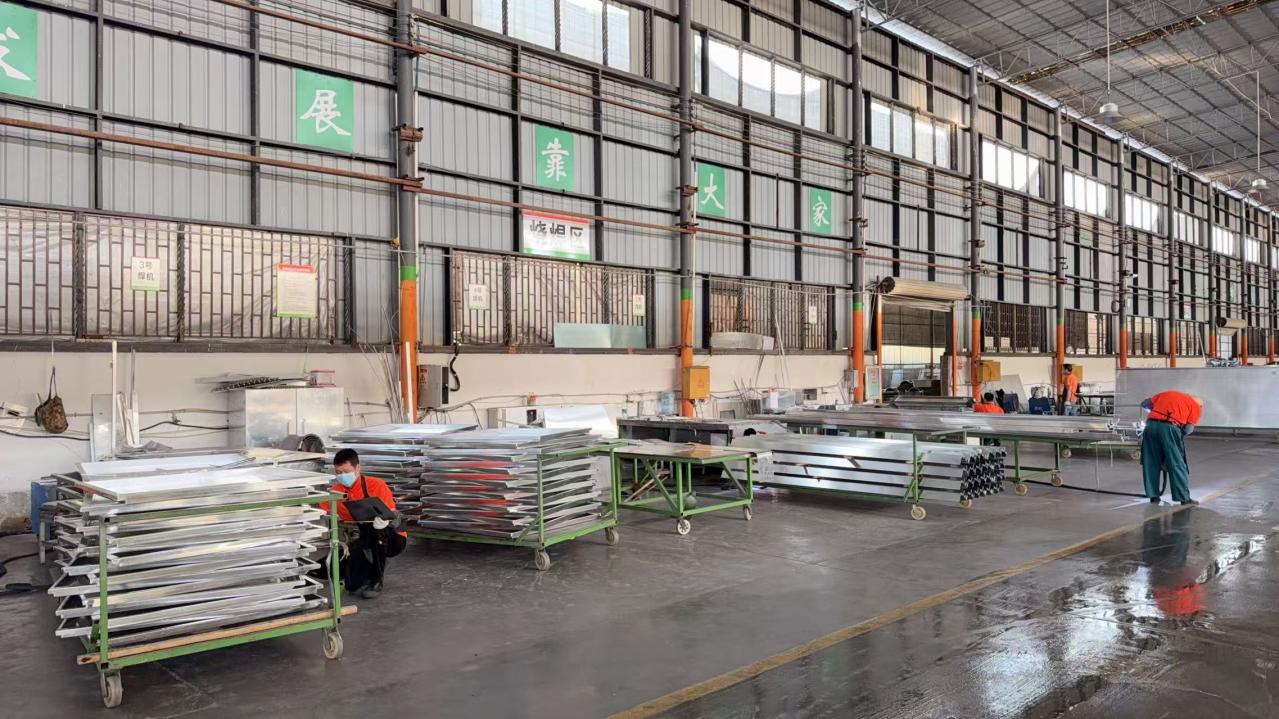
Samples and finish approval: the quiet gate
Finish approval is the gate most programmes forget to schedule, because it looks like a small task. It is not. A honeycomb panel finish is a coating system applied to a specific face sheet, and the approved sample is the only record of what the installed facade should look like. The sample must show the colour, the gloss level, the texture and the direction of any metallic or directional finish, and it must be large enough to judge the finish under the project's own lighting. A small swatch can confirm a colour code; it cannot confirm how a large panel reads on an elevation.
Allow time for more than one round. The first sample may reveal that the gloss reads differently on a large panel than on a swatch, or that a metallic finish changes appearance when panels are rotated. Each round needs a decision, recorded in writing, with the sample retained and labelled so that production panels can be compared against it later. If the finish has a batch character — a metallic or textured coating, for example — ask how production lots will be controlled against the approved sample, and what happens if a later lot falls outside the agreed range.
Finish approval also gates the coating line. A fabricator cannot coat panels before the finish is approved, and a coating slot given away to another order is not easily recovered. Confirm the date by which the finish must be approved to hold the production slot, and put that date in the programme as a milestone with a named owner. A finish decision that drifts by a week moves the delivery date by at least a week, because nothing downstream can start early to make up the time.
Production slots and material: what a slot actually reserves
A production slot is not a promise that panels will be made on a given day. It is a reservation of capacity — press time, coating line time, cutting and folding time, and labour — against a defined scope: a panel schedule, a build-up, a finish and a drawing revision. When any part of that scope changes, the slot should be re-confirmed, because the capacity the slot reserved may no longer match the work. A change from one finish system to another, a change in panel size that alters nesting, or a late addition of perforated panels can each change the time the order needs on the line.
Material is the other half of the slot. Face sheet stock, honeycomb core, adhesive and coating materials all have their own availability, and a slot without material is a date without panels. Ask the supplier to confirm, at the point the order is placed, which materials are in stock, which are ordered for the project and what the confirmed availability is for anything that must be procured. This is especially important for a finish or core variant that is not a regular stock item: the material lead time sits inside the panel lead time, not alongside it, and it is the part of the sequence the buyer sees least.
Do not treat a verbal slot as a booked slot. Ask for the slot in writing, with the scope it covers, the drawing revision it is booked against, and the date by which the preceding gates must clear for the slot to hold. If a gate slips past that date, the honest outcome is a new slot and a new delivery date — agreed early, while there is still time to re-plan the site sequence around it.
Site readiness: the delivery nobody scheduled
Panels that arrive before the site can receive them are not early; they are a storage problem. Honeycomb panels need dry, level storage, protection from impact and a handling route from the unloading point to the installation face. A delivery that arrives while the subframe is incomplete, while the access route is blocked, or while the storage area is occupied by another trade will either wait on the vehicle, be stored somewhere unsuitable, or be handled twice. Each of those outcomes costs time and risks damage to finished faces.
Plan the delivery as part of the programme, not as an afterthought to fabrication. Agree the delivery sequence — which elevations first, in which order, and in which crate groupings — and confirm that the site can receive, check and store each consignment as it arrives. The receiving check should confirm quantities against the packing list, part numbers against the panel schedule, finish against the approved sample, and visible condition before the panels are signed for. A panel that is damaged in transit and discovered only at installation has already lost its place in the sequence.
Finally, protect the programme against the one change that always arrives: a late revision. Agree in advance how a revision is handled — who authorises it, which panels it affects, whether any panels are already in production, and what it does to the delivery date. A revision process agreed before the work starts is a commercial discussion. The same revision discovered on site, with panels already coated, is a dispute. The lead time that survives contact with a real project is the one that was planned as a sequence of gates, with an owner and a date at every gate, and with the site ready when the last gate clears.
Technical references
The sources describe general engineering considerations. Confirm product-specific values and project requirements with the responsible design team.