
FIELD NOTES / HONEYCOMB
Face Sheet Thickness for Large Honeycomb Cassettes
A large honeycomb cassette loads its face sheet differently from a small one. Span, wind pressure, fixing spacing and the core beneath the skin all decide how thick that face sheet needs to be — and overall panel depth alone cannot answer the question.
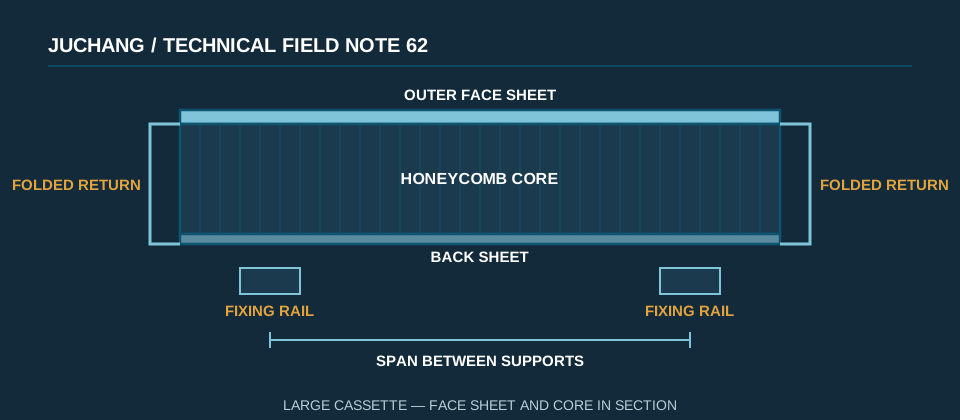
Face sheet thickness for large honeycomb cassettes starts with what the skin has to do
Face sheet thickness for large honeycomb cassettes is a question about what the outer skin is asked to do, not about a number in a catalogue. On a large cassette the face sheet carries wind pressure to the core, holds its shape between fixings, resists the local loads at inserts and fasteners, and keeps the visible surface flat under raking light. Each of those jobs loads the skin in a different way, and a thickness that satisfies one of them may not satisfy the others. That is why the question cannot be answered with a single value, and why a supplier who quotes a face thickness without asking about span, pressure and fixing layout has not yet done the engineering.
Start with the span, because span is what makes a large cassette different from a small one. A cassette that spans between two rails behaves like a plate supported at its edges, and the bending stress in its face sheets grows as the span grows. Double the span and the stress does not merely double — the relationship is steeper than that, which is why a face thickness that works on a modest module can be inadequate on a large one even when the wind pressure and the panel depth are unchanged.
Wind pressure is the second input, and it is a project value, not a product value. The design pressure comes from the building height, the exposure, the local wind climate and the position of the panel on the elevation — corners and upper floors see higher suction than the middle of a sheltered wall. A face sheet thickness chosen for a low, sheltered elevation may be wrong for the same cassette at the top corner of a tall building. Hexcel’s sandwich design guidance makes the same point in general terms: loading, support condition and physical constraints come before the selection of skins and core, and the skins are sized against the loads the sandwich actually sees.
Finally, remember that the face sheet is only half of the sandwich. Its job is shared with the core and the back sheet, and the bond between them. Face sheet thickness is a decision about the whole build-up, taken with the core, the bond and the fixings in view.
Why overall depth alone does not decide face sheet thickness
It is tempting to read overall panel depth as a proxy for strength. A deeper panel is stiffer in bending, because the two face sheets are further apart and the sandwich acts more like a beam. But stiffness is not the same as face sheet stress, and depth does not protect the skin from the loads that act on it locally.
Consider a large cassette under wind suction. The panel bends between its supports, and the face sheets carry the bending as tension on one side and compression on the other. The stress in the skin depends on the bending moment, which depends on span and pressure, and on how much material is in the skin — its thickness. Increasing the core depth reduces the bending moment the skins must resist for a given deflection, but it does not change the fact that the skin itself must carry its share. Two cassettes with the same overall depth can therefore need different face sheets, and a deeper cassette can need a thicker skin than a shallower one if its span is longer or its pressure higher.
Depth also does nothing for the local jobs. A fixing that pulls on the skin, an insert that concentrates a load, or a fold at the edge of the cassette all load the face sheet in a small area. The core beneath the skin and the insert reinforcement decide how that local load spreads, and the skin thickness decides how the skin itself responds. A deep panel with a thin skin can still show a dimple at a fixing, or a wrinkle near a fold, because depth was never the variable that governed that failure mode. The ALUCORE processing guide warns in the same spirit that the build-up must be read as a system — its values belong to the product tested, and they cannot be transferred to a different build-up as a guarantee.
The practical consequence is simple: never accept “a deeper panel” as the answer to a face sheet question. Ask which load the thickness is meant to resist, and what calculation or test evidence supports it for the span and pressure of this project.

The variables that drive the choice
Five variables drive face sheet thickness on a large cassette, and the specification should state all five before a thickness is fixed. The first is the clear span between supports in each direction, with the support arrangement stated — two-way support, one-way support, or a rail layout that changes the effective span. The second is the design wind pressure for the panel’s zone, including suction, with the deflection limit the project allows. A cassette that must stay flat under a strict deflection limit may need a thicker skin, a deeper core, or closer supports, and the three options have different costs and different effects on weight and edge detail.
The third variable is the fixing layout. Fixings that are widely spaced leave long unsupported runs of skin between them, and the skin between two fixings can deflect or dimple even when the panel as a whole passes its deflection check. Fixing spacing also sets the local load at each point: fewer fixings means more load per fixing, and more load per fixing means more demand on the skin, the insert and the core beneath it. The fourth variable is the core itself — its material, depth and density — because the core supports the skin against wrinkling and carries the shear between the two faces. A face sheet that is adequate on a dense core may wrinkle on a lighter one under the same load, which is why the skin and the core are specified together, never separately.
The fifth variable is what else the skin has to carry. A cassette that supports a sign, a light fitting or a handrail loads its face sheet through inserts, and the skin thickness, insert spacing and reinforcement all enter that check. A cassette with a folded return loads the skin at the fold, where the material has already been worked. Each of these is a reason to treat the face sheet as part of a system, and to ask the engineer to confirm the thickness against the full list of loads, not just the wind pressure.
Illustrative example only — the project values come from the project specification: take one large cassette and walk it through the five variables on a single sheet. Write down its span in both directions, its design pressure and deflection limit, its fixing positions and spacing, its core build-up, and every additional load it carries.
Face and back sheets are not always the same
A honeycomb sandwich can use different thicknesses on its visible and concealed sides, and on a large cassette that difference is often deliberate. The outer face sheet faces the weather, the wind and the public eye: it carries the highest bending stress, it must hold the finish flat, and it is the surface that shows oil canning or dimpling when it is too thin for its span. The back sheet is sheltered, unseen and often less heavily loaded, and a thinner back sheet can be the right engineering choice — provided the difference is stated on the drawing and the panel is installed the right way round.
The risk is not the difference itself but the confusion it creates. A panel with two different skin thicknesses has a correct orientation, and a cassette installed back-to-front puts the thinner skin where the thicker one was designed to be. Mark the orientation on the drawing, on the panel schedule and on the panel itself, and check it at receiving inspection.
Different skins also change the way the panel behaves at its edges. A folded return is formed from the face sheet, so the skin thickness sets how the return folds, how tight the radius can be and how the fold carries load into the core. Confirm the return detail against the skin thickness on the approved shop drawing — a return drawn for one thickness and folded in another is a defect waiting to be found at the first inspection.
None of this is an argument for always using the same thickness on both sides. It is an argument for writing both thicknesses down, with the reason for each, and for checking that the factory, the installer and the inspector are all working from the same numbers.
What to ask for before the thickness is fixed
Before a face sheet thickness is fixed on a large cassette, ask for five things, and ask for them in writing. First, the design inputs: span and support arrangement, design wind pressure for the panel’s zone, deflection limit, and every additional load the cassette carries. Second, the full build-up the thickness belongs to — both skin thicknesses and alloys, core material and depth, cell size or density where specified, bonding system and edge closure — so the thickness is never quoted on its own. Third, the calculation or test evidence that connects the inputs to the thickness, with the assumptions stated.
Fourth, the local checks: insert and fastener pull-out evidence for the fixings proposed, the permitted distance from fixing to panel edge, and the check on face wrinkling and local compression where the skin is loaded through a small area. A panel can pass its midspan deflection check and still fail at a fixing, and the evidence for the local check is as important as the evidence for the span. Fifth, the sample and the record: a production-representative sample showing the agreed build-up, and a panel schedule that records the thickness against the panel size, position and zone it belongs to.
Record the decision the way it was made. The approved drawing revision, the design pressure it used, the calculation or test it relied on, and the sample that approved the finish and the build-up together form the audit trail.
A large cassette earns its size when every part of it is sized for the span it actually covers. State the loads, state the build-up, show the evidence, and let the face sheet thickness be the answer those inputs produce — not a number carried over from a smaller panel that happened to work.
Technical references
The sources describe general engineering considerations. Confirm product-specific values and project requirements with the responsible design team.