
FIELD NOTES / HONEYCOMB
How to Choose Honeycomb Core Density for a Facade Panel
Core density is a project decision, not a catalogue default. The density of the honeycomb core changes how a facade panel carries shear, holds a fixing and resists local crushing — so it deserves the same design attention as the face sheets and the overall depth.
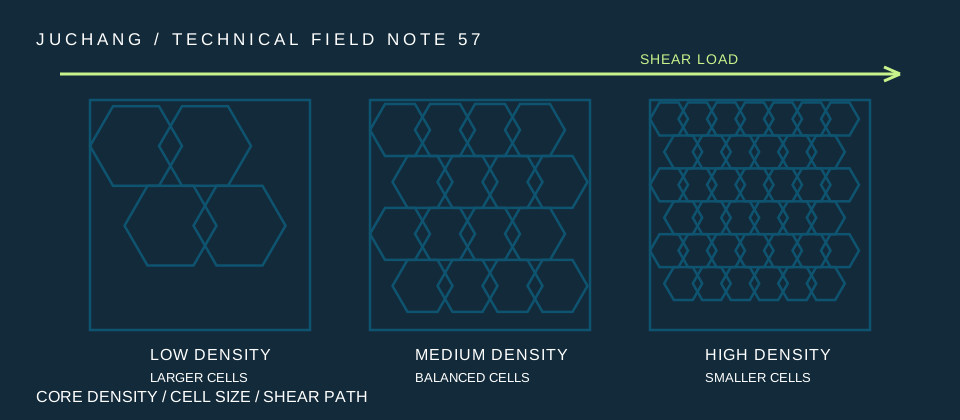
Core density is a decision, not a default
Core density is the mass of honeycomb material in a unit volume of the core layer, and it is usually stated in kilograms per cubic metre on the core manufacturer's data sheet. It is not a property of honeycomb in general: two panels of the same overall depth can carry cores of very different density, and the difference shows up in how the panel behaves rather than how it looks. Density governs how much cell wall material is available to carry shear between the two face sheets, how much area the adhesive has to bond to, and how the core resists being crushed where a fixing or an insert bears on it. It also sets a share of the panel weight, which matters once the panel area runs into the hundreds of square metres.
The reason density deserves its own decision is that most suppliers stock one or two core densities as a standard, and the standard is chosen for the average job. A tall facade cassette with wide fixing spacing is not the average job, and a small interior panel is not either. Accepting the catalogue default without asking what it is leaves the one variable that links the face sheets to the fixings undecided. The first step in choosing it is to ask the supplier to state it: core material, density in kg/m³, and cell size, in writing, for the exact build-up being quoted.
Start with what the panel has to do
Before comparing densities, fix the demands on the panel. The inputs that matter are the cassette size, the spacing between supports, the design wind pressure, the deflection limit the project sets, the fixing arrangement, and the exposure the panel will face. The load path runs from the wind pressure on the outer face sheet, through the core in shear, into the fixings and then into the subframe — and core density governs the middle step of that path. A large cassette on wide supports asks more of the core than a small panel on close supports, even when the wind pressure is the same. That is why two facades with identical panels on paper can need different cores: the span and the fixing pattern changed, so the shear demand changed.
Ask the responsible engineer which checks govern the panel before any density is chosen. In most facade cassettes the shortlist is core shear, face wrinkling under compression, local compression where a fixing or insert bears, and deflection at midspan. Hexcel's sandwich design guidance makes the same point in general terms: loading, support conditions and physical constraints come first, and the skins and the core are selected against them. A density chosen before those inputs are fixed is a guess, and a guess made early tends to survive into the fabrication drawings unchallenged. Set the inputs down on one page — size, span, pressure, deflection limit, fixing positions — and the density conversation becomes a check against numbers rather than a preference.
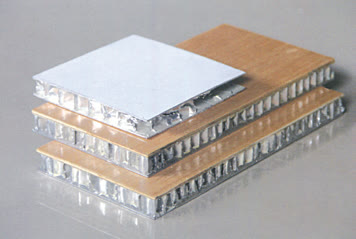
What higher density actually buys — and what it costs
A denser core buys real performance, but only where the core is the limiting part. More cell wall material per unit volume raises the core's shear capacity, improves its resistance to crushing under a concentrated load, gives the adhesive more wall area to bond the face sheets to, and helps the outer skin resist wrinkling under compression. Where a cassette carries heavy fixings, a large insert or a wide span, those are the checks that move. The cost side is weight and price: a denser core is heavier, and across a facade of several hundred square metres the extra kilograms add up in handling, in the subframe and in freight. It also costs more per square metre, and the performance gain flattens as density rises — doubling the density does not double what the panel can do, because the face sheets, the bond and the fixings often govern before the core does.
A lighter core has the mirror-image case: it is cheaper and lighter, and it is perfectly adequate where spans are short, fixings are well spread and no concentrated load bears on the panel — but every fixing point still needs its local crushing check, because a light core has less material to spread that load. As an illustrative example only — the values are not a specification — consider a cassette whose only change is the core: stepping the density up raises the panel weight and the material cost, while the midspan deflection barely moves, because the face sheets and the span already govern it. The check that does move is the local one, the bearing stress under a fixing. That is the pattern to look for: density pays where the local checks govern, and it is mostly weight where they do not.
The questions to put to the supplier
Put these questions to the supplier, and ask for the answers against the exact build-up being quoted. What is the core material, the density in kg/m³ and the cell size? What are the compressive and shear values for that core — taken from the core manufacturer's data sheet for the exact core, not from a generic honeycomb figure? What test evidence exists for the complete build-up, face sheets plus core plus adhesive, rather than for the core alone? How is the density maintained at folded returns and around inserts, where the core is cut, crushed or replaced by an edge closure? Is the density the same across the whole panel, or does it vary near edges and fixings? And what changes if the density is stepped up or down — weight per square metre, cost, and availability?
A density quoted without the core material and the cell size is incomplete: two cores at the same nominal density can behave differently when the material or the cell geometry differs, and a value taken from another supplier's data sheet proves nothing about the panel being quoted. Treat any density figure that arrives without its source as a placeholder, not a decision. Once the answers are in, write the chosen density into the specification and the panel schedule — material, density, cell size — alongside the face sheets and the overall depth. A value that lives only in an email thread will not survive a drawing revision.
A selection sequence that holds up in review
A selection sequence that holds up in review runs in this order. First, fix the cassette size, the support spacing, the design wind pressure, the deflection limit and the fixing positions, and have the responsible engineer confirm which core checks govern. Second, ask the supplier for the core options that satisfy those checks, with data-sheet values for each option rather than a single recommended density. Third, compare the options on weight per square metre and on cost, and check availability — a density that is not a stock item can carry a longer lead time, so confirm per project rather than assuming it. Fourth, confirm the chosen density with the responsible design team and record it in the specification and the panel schedule, with the core material and cell size beside it. Fifth, make sure the sample and the mock-up use the same core: a sample built on a different density proves the finish, not the structure.
Density is a single line on a specification, but it connects the face sheets to the fixings, and it is far cheaper to decide it on paper than to re-engineer a cassette after the panels are in production. Choose it the way the panel works — from the loads inward — and the rest of the specification follows.
Technical references
The sources describe general engineering considerations. Confirm product-specific values and project requirements with the responsible design team.