
FIELD NOTES / HONEYCOMB
Honeycomb Panel Cassette Fixing Detail: What to Show on the Drawing
A cassette fixing detail is a coordination document, not a decoration. It should show the whole load path — from the face skin, through the core and the folded return, into the fixing and the rail — plus the movement strategy and the evidence behind every insert.
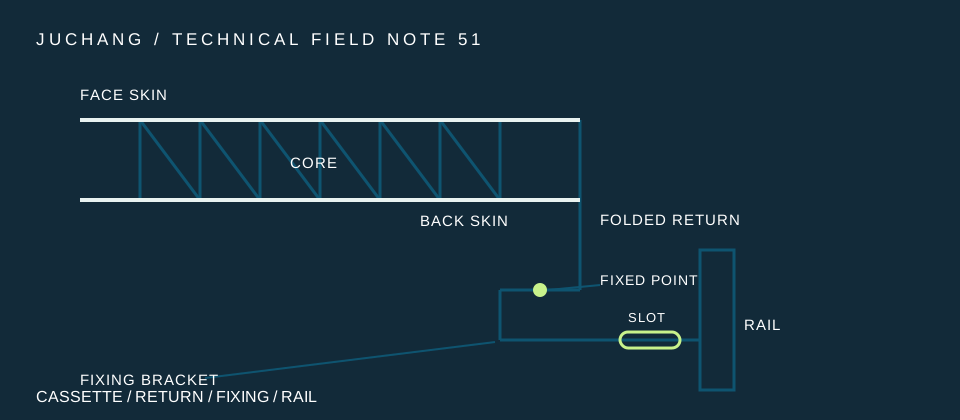
A fixing detail answers one question: where does the load go?
A cassette is a folded panel, and a fixing detail that only shows a screw has missed the point. Wind pressure, self-weight and any applied load arrive at the face skin, travel through the bond into the core, cross the folded return, pass through the fixing and the bracket, and reach the rail and the structure. Every handoff in that chain needs a home on the drawing: what carries the load, what it bears on, and what keeps it from moving the wrong way. If any link is missing, the detail is a picture of a fastener, not a fixing.
Start the detail with the inputs it was checked against. The drawing should state the design pressure, the support spacing and the deflection criterion as project values, not as catalogue claims. Hexcel's sandwich design guidance begins with loading, support condition and physical constraints before any skin or core is selected, and a fixing detail follows the same order: loads first, hardware second. A reviewer should be able to read the detail and say what load the fixing was sized for, without opening another document.
Then show the whole chain in one section. A single cross-section through the fixing, drawn at a scale where the return, the bracket and the rail are all legible, is worth more than three partial details. Label each part and each interface: skin to core, core to return, return to bracket, bracket to rail, rail to structure. Where the chain changes material, aluminium to steel for example, the detail should show the isolation that keeps dissimilar metals apart where moisture is present.
Draw the folded return and the edge closure in the same section
The folded return is where a cassette gains its depth, and it is usually where the fixing lands. That makes the return the busiest part of the detail, and the part most often drawn incompletely. Show the return depth, the fold itself and the edge closure in the same section, because they share the same space and the same risks. A return drawn without its closure invites two problems at once: water finding the exposed core edge, and handling damage at the thinnest part of the panel.
The closure deserves its own callout: closure type and material, how it is fixed, and whether it is sealed. A closure that is only implied by a line on the drawing will be improvised on site, and an improvised closure is where leaks and rattles start. The same section should show the drainage path, if the detail relies on one. Water that reaches the joint must have a way out that does not pass through the core.
Check the return against the fixing, not just against the elevation. The bracket needs bearing area on the return, and the fastener needs edge distance from the fold. A return that is too shallow for its bracket forces the fixing toward the fold, where the skin is bent and the core is disturbed. Put the bracket, the fastener and the edge distance on the same drawing, at the same scale, and the conflict becomes visible before fabrication, when it is still cheap to fix.
Fix the panel at one point and let it move everywhere else
A honeycomb cassette grows and shrinks with temperature, and the fixing detail is where that movement is either accommodated or fought. The ALUCORE processing guide calls out thermal expansion when selecting joints and fixings for outdoor use, and the principle it points to is simple: fix the panel at one defined point and let every other fixing slide. A detail that draws every fixing as a rigid round hole contradicts its own movement strategy.
Show the fixed point on the drawing and name it as the datum. It usually sits near the centre of the cassette or at a defined edge, and every sliding point is measured from it. Each sliding fixing needs a slot, a slot direction and a slot length as project values. The slot must be long enough for the movement the panel will actually see, and its direction must follow the panel's expansion, not the convenience of the drill. A slot drawn without a length is a guess.
An illustrative example shows how the numbers work. Take a cassette 1,200 mm wide, a project temperature range of 40 degrees C, and aluminium's coefficient of thermal expansion of 23 x 10-6 per degree C: the movement from the fixed point to one edge is roughly 1,200 x 40 x 23 x 10-6, about 1.1 mm. That is an illustrative example only. The project temperature range, the cassette width and the coefficient come from the project specification, and the drawing must record the resulting slot length as a project value. The point of the example is the method: the slot length is calculated, not copied from a previous job.
The rail side of the movement matters as much as the panel side. The bracket and the rail must allow the same travel without binding, and the detail should show the clearance that makes that possible. Where a fixing is drawn tight against a slot end, the panel has nowhere to go when it warms up, and a panel with nowhere to go will bow, rattle or load its fixings in a direction they were not drawn for.
Inserts and pull-out evidence belong on the detail, not in a footnote
Where a fixing lands in the core field rather than on a folded return, the load passes through an insert, and the insert is the detail. Show its type, its engagement with the skins and core, its edge distance from the panel edge and from the next insert, and the reinforcement around it. An insert drawn as a small circle with no callout leaves the installer to choose the hardware, and the hardware chosen on site is rarely the hardware the detail was checked for.
The evidence for an insert belongs with the detail, not in a footnote on another page. A pull-out result is tied to the fastener geometry, the engagement material and the specimen configuration it was tested on, so the detail should reference the test that matches the proposed build-up: same skins, same core, same insert, same edge distance. A result from a different build-up is not evidence for this one, and a detail that cites no evidence at all asks the reviewer to trust the fixing on faith.
Say on the drawing whether the fixing lands on a return or in the core field, because the load path is different in each case. A return fixing bears on folded metal; a core-field fixing bears on an insert bonded into the sandwich. Mixing the two without saying so is how a fixing that works on one elevation fails on the next, where the same cassette is fixed a different way.
A submittal checklist for the cassette fixing detail
Before the detail is issued, run it against this checklist. First, one section through the fixing that shows the whole load path, from face skin to structure, with every interface labelled. Second, the folded return and the edge closure in the same section, with the closure type and material called out and a drainage path shown. Third, one named fixed point and sliding points with slot direction and length as project values. Fourth, every insert with its type, engagement, edge distance and the pull-out evidence for the matching build-up. Fifth, the rail interface: bracket, fastener material, isolation from dissimilar metals, and the tolerance the detail allows.
Then ask the supplier to confirm the assumptions in writing: the design pressure and deflection criterion the detail was checked against, the temperature range behind the slot lengths, and any excluded work, subframe design for example, or engineering of the support structure. A fixing detail that states its assumptions can be reviewed; one that hides them can only be believed. The cheapest time to find a missing assumption is on the drawing, before the first cassette is cut.
Technical references
The sources describe general engineering considerations. Confirm product-specific values and project requirements with the responsible design team.